The housekeeper at my hotel room door
is trying to tell me something.
She points to my unmade bed,
the freshly stacked towels,
says she is sorry the sheets
are still pulled back and rumpled.
I start to tell her it's okay, no problem,
de nada, when the Albanian poet
speaks up:
she's saying she didn't make your bed
because you left your pajamas on it,
and she won't touch your personal things.
And now, translation's grateful wake of smiles
passes through the room, and I tell
the housekeeper not to worry.
As the door closes, the Albanian rocks
her baby close, and explains
I speak immigrant.
I do, too. But I speak the kind
of a man with a foreign engineering degree
pacing Manhattan with the kind of hunger
it takes to feed a family.
It's true, sometimes, what they say
about our own kind.
Another Jew hired him, took a chance
on the greenhorn, saw him
through his night school master's degree.
The humble language of service,
of people's rumpled and unwashed selves,
is one I was never expected to learn;
my door, a threshold
of Babel.


12/11/2010
Charlotte 1, or Poem from iWPS
It's been a great two nights here in Charlotte. The poetry quality is high, and the competition has been full of surprises. I've gotten to spend time with many of my usual suspects, and some newer friends, who've come to the forefront in others' absences. And now, Poem-a-day #345:
Sometimes, I forget: many poets
don't know I can sing.
And the kids I teach don't know
that I struggle through the same
assignments I bring to their table.
And then Claire picks up her banjo
and begins to practice
on the edge of our beds,
filling the spaces between
the day's many, many words.
It is the most beautiful kind of
noise, this time of day.
I never believed my mother
when she told me she loved
to hear my piano mistakes
over and over again
from the next room.
Claire stops a lot,
and sometimes sighs
at herself like a swear word.
She apologizes for the mistakes,
and I think of my mother,
chopping onions in time to
halted Chopin preludes,
begging me to keep going
when the timer went off.
12/09/2010
Somewhere over Minnesota 1, or We Really Live in the Future
So, I write this from a plane, which makes it a little hard to tell where I am, because the clouds are in the way. In yet another moment brought to you by We Live In The Future, Now, I am on a plane, on the internet, for free. Seriously.
Anyway, I've been traveling again, which means it's time to blog! I flew down from Seattle to San Francisco on Sunday, and happily bounced around from D's new house (complete with three delightful, warm, welcoming housemates) to visiting beloved cousins J and A up at their house on the big hill in Santa Rosa.
My first night in the Bay area, I went to a small house show that seemed a lot like the Kibbutz's montly Coffeehouse - friends gathering to share artistic work and get feedback. One thing this show did differently was require artists to ask for exactly what kind of feedback they wanted. One person showed video clips of her new clowning act. Another did a monologue about her new one-woman show, still in the research phases. I read a few poems. We ate salmon and greens and tabouli, and talked about heady art things. I haven't had such an abstract conversation since college, I think, but I enjoyed it.
I did a small house show at J&A's place, which is uniquely suited for poetry house shows - it's really as much an art space as it is a house, thanks to A, who has spent the last couple of decades in paint, jewelry and sculpture. About five of their friends came over to nosh, drink, and hear from "J's young cousin, who's passing through town and reciting poems." I got to read a whole bunch from the Raizl/Rachel series, as well as some smaller work - less of the big slam stuff. They loved it. I loved it. Honestly, I love performing to people my parents' age. There's something about that generation - they're so unjaded about poetry, so completely unsullied by expectation. Or rather, their expectations are so incredibly low that I can be sure I'll surprise them in a good way.
Next up: Charlotte, NC, where I'll be volunteering at the Individual World Poetry Slam. Take advantage of the time change, loves - give me a call!
(this entry has been Posted From An Airplane. Seriously. Seriously.)
11/23/2010
Seattle 148, or And It's Beginning to...

When it snows in Seattle, the collective head comes off and the proverbial (and actual) chickens start running around. Or, rather, people turn into idiots. Real idiots. Idiots who would try to gun it up a hill that's covered in ice with cars close in front of them. Idiots who don't know how to control a skid. Idiots who don't have chains for their tires, don't own snowboots, and seem to think sledding is best done when wildly intoxicated.
The roads are closed. There are no snowplows. There is no salt or sand, or that disgusting organic molasses byproduct that got really popular in Massachusetts one year. In any self-respecting temperate climate, this would be a non-issue. The snow stopped around 2am - it could've been cleared by 5. But it wasn't. Because there are no g-ddamn plows.
I worked a 14 hour emergency shift, because I could walk to work instead of relying on the buses. It took one of my cowokers six hours to make her 20 minute commute. A new client was dropped off at 2am because the highway turned into a parking lot. The school expects at least two, maybe three snowdays from this.
I'm not leaving the house until I have to. I've got my nice cozy fire going, and promises of rice pudding, and I will leave the insanity where it is, thank you.
But I will say this: there is something wonderful about a pink sky over snowy evergreens, and the companionable silence that comes from empty roads.

11/17/2010
Seattle 147, or Ode to Joy
When the rain comes like a cold scolding, I do my best to brighten the kitchen.

(or, as this case may be, an ode to my father)

(can't claim these - they're Joel's. But I know how to make them.)

(Skagit River Ranch bacon is the only kind I've ever had that beat Oscar's.)

(purple cauliflower! who knew?)

11/11/2010
Seattle 146, or A Joke to Share
I had a moment somewhat like this, recently.
After months of negotiation with the authorities, a Talmudist from Odessa was finally granted permission to visit Moscow. He boarded the train and found an empty seat. At the next stop, a young man got on and sat next to him.
The scholar looked at the young man and he thought: This fellow doesn’t look like a peasant, so if he is no peasant he probably comes from this district. If he comes from this district, then he must be Jewish because this is, after all, a Jewish district. But on the other hand, since he is a Jew, where could he be going? I’m the only Jew in our district who has permission to travel to Moscow.
Ahh, wait! Just outside Moscow there is a little village called Samvet, and Jews don’t need special permission to go to Samvet. But why would he travel to Samvet? He is surely going to visit one of the Jewish families there.
But how many Jewish families are there in Samvet? Aha, only two – the Bernsteins and the Steinbergs. But since the Bernsteins are a terrible family, so such a nice looking fellow like him, he must be visiting the Steinbergs. But why is he going to the Steinbergs in Samvet? The Steinbergs have only daughters, two of them, so maybe he’s their son-in-law. But if he is, then which daughter did he marry? They say that Sarah Steinberg married a nice lawyer from Budapest, and Esther married a businessman from Zhitomer, so it must be Sarah’s husband. Which means that his name is Alexander Cohen, if I’m not mistaken.
But if he came from Budapest, with all the anti-Semitism they have there, he must have changed his name. What’s the Hungarian equivalent of Cohen? It is Kovacs. But since they allowed him to change his name, he must have special status to change it. What could it be? Must be a doctorate from the University. Nothing less would do.
At this point, therefore, the scholar of Talmud turns to the young man and says, “Excuse me. Do you mind if I open the window, Dr. Kovacs?”
“Not at all,” answered the startled co-passenger, “But how is it that you know my name?”
“Ahhh,” replied the Talmudist, “It was obvious.”
11/07/2010
Seattle 145, or Poem-a-day #309
Raizl, Forhenwald, Bavaria, 1945
The Red Cross worker
says, in halting Polish,
“Don’t you like the soup?
It’s not my mother’s,
but at least the meat is real.”
How can Raizl explain?
Meal after meal,
she sits, clutching her spoon,
eating less than a bite,
naming the pieces of food:
this one is Aleksy,
(he loved potatoes)
this pepper, Elzbieta,
(who we called Erzi,
because she was Hungarian,
and moaned
that our food had no taste)
this piece of meat,
Jaga, gone,
just after the liberation,
as though she knew
her work was done.
“Maybe it’s too hot?”
says the Red Cross woman,
reaching to touch the side
of Raizl’s tin bowl.
When she finds it cold,
she shakes her head.
“Look at yourself!
You need to eat something;
you look like you just
came out of the camps!”
Raizl imagines
pinching a piece of meat
between her thumb and forefinger,
touching it to Aleksy’s lips,
leaving a meatgrease kiss.
They were all so hungry.
10/29/2010
Seattle 144, or Cider House
When I got the invitation, I almost squealed out loud. A cider pressing, in the next neighborhood over, at the brightly painted co-op. Bring your apples - your bruised, your half-eaten, your yearning to be crushed and poured and savored. E had a rickety old press, borrowed from yet another co-op, which featured a PVC pipe for a crank and so little glue we sometimes held it together with our knees.
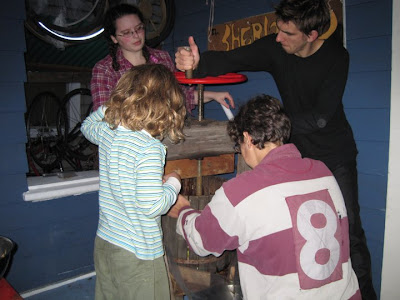
When I arrived, groaning bag slung over my back, I found the beginnings of an assembly line. I slipped in to share a cutting board, grabbed a knife from the wall, followed the labeled cabinets to a towel and colander, washed my apples and joined the group. A child sat at the table, doing math problems. Her mother sat next to her, knife in hand, talking and tossing cores into a bowl. We chopped until we filled the stock pot - big enough to bathe in, it came nearly to my hip.
Dinner materialized when it got dark - the long kitchen table slowly moved from apples to potluck - beet salad and fresh bread, my sundried tomato-walnut pesto over pasta, ghost-shaped cookies, banana muffins. The house was full, and noisy, everything spilling over. I took a break from the press, prowled the common rooms of the house, let the surroundings tickle me: a bathroom sink, disconnected from its pipes so the water dropped straight into a bucket to be used for flushing the toilet. A labeled cabinet by the front door reading "extra blankets." Copies of letters written to company heads and political figures. The hall table with the blank name tags and jar full of markers, with specific instructions to include one's preferred pronoun. The hall telephone with the sticker "this phone has been tapped by order of the US Patriot Act." The jerryrigged feat of a kitchen.
It turned out that only E and I knew how to use the press - how to dump the chopped apples into the hopper, grind them down and then use the wooden paddle, the giant screw, and the apples' own weight to press until juice ran in sweet, thin rivulets into the bucket. Each cycle took about twenty minutes from start to finish. I remembered the cider party at Red Truck, the honey harvests from my childhood, Apple Days when visiting Marlboro. This party had the same harvest joy, the sticky hands of plenty.
After three nonstop hours of pressing, we had about five gallons - not counting the stuff we'd drunk in celebration or sent home with people. Most of it went into the basement - E wanted to experiment with fermenting it. I walked home with a mason jar of cider cradled in my sweater, sweet, grimy fingers, delight at seeing my breath. Autumn, indeed. Who needs foliage when there's cider and early sunsets?
10/26/2010
Seattle 143, or poem-a-day #300
They ignore me, mostly.
Not impolitely -
they are obedient
as crocuses,
perfectly willing
to take the broom
or mop
or towel
and complete their chores
without my asking,
or to say "good!"
and flash me a thumbs-up
when I serve them food.
We color together;
today we carved a pumpkin.
They cracked roasted seeds
between their teeth, suckled
the salt.
Their conversations
bounce across the rooms,
missing me each time.
My workday
is not quite loneliness
or boredom,
but draws a card from each.
Sandra comes out of her room
with a plastic bag in her hand,
offers the contents around.
When she reaches me,
I look into her palms,
take a piece of dried fruit
covered in spices,
take a bite.
I smile, flash her a thumbs-up.
"Bueno!"
She chatters at me in Spanish
for a few seconds,
before both our faces fall
in that familiar way
of Babel.
Finally, she says
"Mannngooo"
and
"Mi Mamaaa,"
with a kind of patience.
I smile.
"Mango - tu mama."
And she smiles.
And we nod,
chewing,
this other woman's home
reaching my throat.
10/18/2010
Seattle 142, or Tastes of my new home
Autumn in Seattle leaves me an odd mix of restless and sluggish. There's lots of news: I have a new job, working with homeless youth. It's different than my old job; they're older, more functional. No restraints. No side-hugs. No laundry. No monitoring every conversation between clients. Clients that can sustain a conversation, though - that's awesome.


Last week, I started craving chopped liver. It's not something I ate all the time as a kid - just often enough to remember how much I liked it - earthy, salty, with hints of egg and onion. In my grandmother's Queens apartment, they served it in a cut glass bowl. I pinched mouthfuls when no one was looking; the adults always spread a thin layer over crackers and rye bread. "Too rich," I was told when I asked for a spoonful.
Sometimes, when my other grandmother was roasting chicken, I'd catch her before she tossed the liver and beg her to fry it up for me. She always did, muttering about cholesterol as she flipped it in the pan.
At the store, they sell them frozen, six or seven in a package, for cheap. I looked up a few recipes online, found the basic ingredients and set to work. The livers went under the broiler, salted, their thick smell stampeding through the house. Masha came home, smiling. My once-Swiss landlord came by, leaned against the counter and took a long sniff. "We used to fry them in butter, as hot as we could," she said. I explained why I was using olive oil, mincing onions to throw in the pan after the livers.
She stayed while I mixed, boiled and chopped, eating slices of the rye bread I'd bought to go with it. No time to start a fresh sourdough.
The smell of onions is home. The smell of liver is comfort, the promise of luxury to come. The eggs, perfectly hardboiled and chopped, turn it creamy, as does the spoonful of unorthodox mustard. Landlord and I eat half-sandwiches, topped with little vinegar pickles in the late afternoon sun. She closes her eyes as she chews, saying "it's different, of course, but you can't beat that taste. It's so humble."
This is me making home: a collection of tastes and smells and sounds that didn't come from anywhere but my own heart. It's the most honest thing I know how to do. And you may not see where it came from, may call it pretense, fabrication, construction - there are so many names for the things we don't understand, the things we also call G!d.
I am telling you: this is where I come from, now. I come from my kitchen, wherever it is.
Subscribe to:
Posts (Atom)